
LResearch library · source navigator

Sources and bibliography

Primary-text leads, subject literature, historical material and public research resources. Each source retains its related dossier and context for search, comparison and citation.
34dossiers58external research entries48core terms
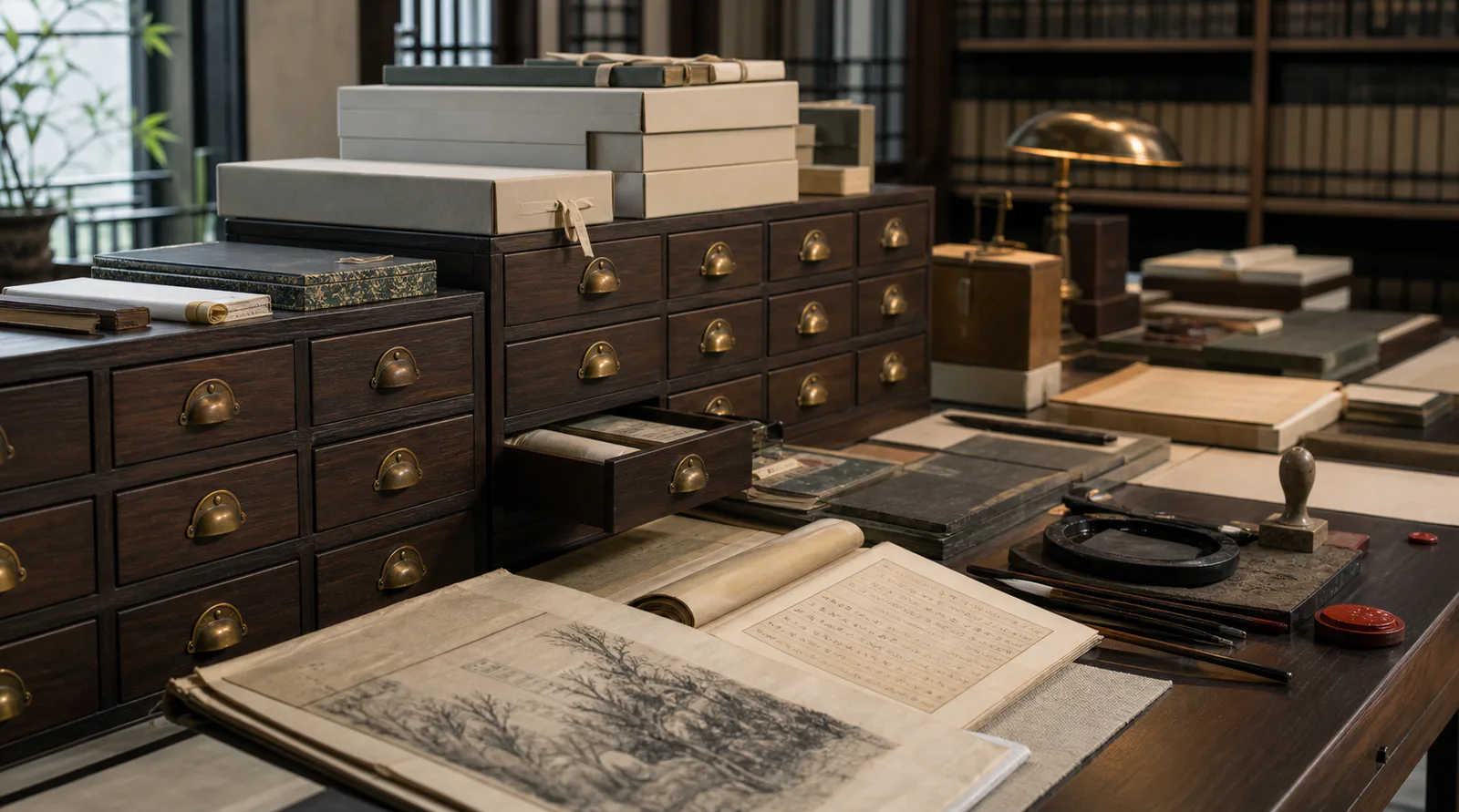
A research table joining texts, catalogues, manuscripts and digital resources

01Four research routes

Find sources by research question

One name may belong at once to method, history, text and social practice. These four routes interconnect, but answer different questions.

02Layered reading

Three depths of reading

The library separates public orientation, specialist study and independent research. You may move quickly, but should not skip checks of terminology, period and source type.

  1. 01

    Public orientation

    Read atlas summaries, the historical overview and glossary definitions to establish names, periods and families.

    For first encounters with Chinese mantic arts
  2. 02

    Specialist study

    Enter a dossier's principles, texts, evidence limits and related systems; record differences among editions and lineages.

    For learners with a defined field
  3. 03

    Independent research

    Return to primary texts, catalogues, archaeology and institutional databases; publish citations, procedures and uncertainties.

    For papers, translation, reconstruction and digital projects

03Evaluating sources

Six dimensions of source evaluation

An institutional page may offer only an introduction; a lineage manuscript may preserve a valuable lead. Evaluation asks exactly what a source can establish, regardless of institutional or lineage status.

01

What is the material?

Received edition, excavated manuscript, object, oral account, paper and modern manual support different claims.

02

How is it dated?

Separate the date claimed in a text, the surviving edition, attribution and the date of modern cataloguing.

03

Can the passage be located?

Record chapter, fascicle, page, edition, collection number or a stable link whenever possible.

04

Tradition or research conclusion?

Layer lineage interpretation, cultural narrative, historical claim and modern validation.

05

Can the procedure be reproduced?

Charts and calculations require inputs, rules, calendar conventions and intermediate steps.

06

Are the limits explicit?

Cases do not generalize automatically; mantic content does not replace medical, legal or financial advice.

04Source catalogue

Public source catalogue

These links are the sources already annotated in dossiers and the history: museums, universities, research institutes, academic publishers and digital text projects. External content and availability remain under the responsible institution.

Current context · 纳甲六爻

6 / 58 sources

zh.wikisource.orgWeb pageTranscribed historical figure charts

增刪卜易 · 八卦各宮全圖

Lists polarity, branches, kin and host–response markers for all sixty-four figures, supporting comparison with the work's procedural chapters.

Responsibility
Transmitted Zengshan Buyi text; Wikisource transcription
Identifier / locator
八卦各宮全圖 · 本次读取 oldid 2100341
Year and version
Online transcription; underlying copy and printing date not established from images
Related reading纳甲六爻
Reading and citation notes
Locating the evidence
Locate the eight palace groups, especially Guan in Qian, doubled Gen in Gen and Xu in Kun.
Scope and limitations
Wikisource transcription without image collation; some names and characters are uncertain. Chapters four through seven are additional locators in the same work, not independent witnesses.

Note reviewed

Open source
zh.wikisource.orgWeb pageHistorical branch-assignment procedure

增刪卜易 · 渾天甲子章第四

The Huntian Jiazi chapter lists inner and outer branch triples and illustrates upward assignment with Gou.

Responsibility
Transmitted Zengshan Buyi text; Wikisource transcription
Identifier / locator
第四章 · 本次读取 oldid 2100293
Year and version
Procedural transcription with a recorded suspect reading
Related reading纳甲六爻
Reading and citation notes
Locating the evidence
Chapter four, Huntian Jiazi: inspect the inner/outer lists and Gou example. The entries used for Gen are transcribed with Chen in the headings.
Scope and limitations
This site labels the suspect Chen headings as Gen by comparison with the same work's Gen chart, explicitly recording that editorial judgment. Image verification remains outstanding. The experiment assigns branches, not heavenly stems.

Note reviewed

Open source
zh.wikisource.orgWeb pageHistorical relational assignments

增刪卜易 · 六親歌章第五

The Six Kin chapter lists parents, siblings, offspring, wealth and officials relative to palace phases.

Responsibility
Transmitted text with separate modern Yuanjian commentary; Wikisource transcription
Identifier / locator
第五章 · 本次读取 oldid 2100292
Year and version
Online transcription with modern annotation distinguished from historical text
Related reading纳甲六爻
Reading and citation notes
Locating the evidence
Chapter five's palace lists and Qian example; the later Yuanjian an passage is a separate commentary layer.
Scope and limitations
Keep the modern note separate from transmitted wording. The site's phase function formulates the listed assignments; modern commentary is not direct evidence of historical wording.

Note reviewed

Open source
zh.wikisource.orgWeb pageHistorical host–response rules

增刪卜易 · 世應章第六

The host–response chapter uses Qian's eight figures to locate the host and its response three positions away.

Responsibility
Transmitted Zengshan Buyi text; Wikisource transcription
Identifier / locator
第六章 · 本次读取 oldid 2100291
Year and version
Online transcription compared internally with the Eight-Palace charts
Related reading纳甲六爻
Reading and citation notes
Locating the evidence
Chapter six, from the root host at line 6 to wandering soul at 4 and returning soul at 3. Compare Tiandi Guan here with Fengdi Guan in the chart.
Scope and limitations
The name discrepancy is retained. The site uses the chart's Xun-over-Kun figure without claiming a critical edition. Host–response labels do not directly identify real persons.

Note reviewed

Open source
zh.wikisource.orgWeb pageHistorical transformation rules

增刪卜易 · 動變章第七

The transformation chapter gives polarity changes and retains the original reference for transformed kin, with examples including Xu to Song.

Responsibility
Transmitted Zengshan Buyi text; Wikisource transcription
Identifier / locator
第七章 · 本次读取 oldid 2100290
Year and version
Online transcription; diagram, prose and editorial exercise kept distinct
Related reading纳甲六爻
Reading and citation notes
Locating the evidence
Chapter seven's Xu/Song diagrams and closing kin rule. Shen at line 4 is marked moving; the later statement about non-moving Shen is logged separately as a diagram–prose discrepancy.
Scope and limitations
The exercise declares changes at 1, 3, 4 and 6 without assuming away the discrepancy. Complete transformed structure and actual moving lines are distinguished. Predictive performance has not been established.

Note reviewed

Open source
dl-library.net.cnWeb pageLibrary catalogue record

增刪卜易 · 大连图书馆记录4987

Dalian Library's Zengshan Buyi entry gives record 4987, call number 1862-21 and accession 7352.

Responsibility
First contributor catalogued as Yehe Laoren (Qing); Dalian Library catalogue
Identifier / locator
记录号4987 · 索书号1862-21 · 登录号7352
Holding institution
Dalian Library
Year and version
Recorded language: Japanese; Mantetsu material; publication year unconfirmed
Related reading纳甲六爻
Reading and citation notes
Locating the evidence
Inspect the first contributor Yehe Laoren (Qing), language Japanese and Mantetsu-material fields. No confirmed publication year is supplied.
Scope and limitations
Catalogue-only review without page-image examination. Retain Japanese as the recorded language rather than inferring a Chinese-language copy. Contributor era does not date the item.

Note reviewed

Open source

RIS export retains filtered results and verified bibliographic fields. Translators and holding institutions remain notes; manuscript dating is not a publication year. Unverified fields stay blank.

05Citation record

Elements of a citation record

When pages, editions or interpretations change, a clear record lets you and later readers retrace the same evidentiary path.

  1. 01Author or responsible institution
  2. 02Title and document type
  3. 03Edition, fascicle or collection number
  4. 04Stable URL and access date
  5. 05Page number for the cited passage
  6. 06Your inference separated from the source