
LResearch library · source navigator

Sources and bibliography

Primary-text leads, subject literature, historical material and public research resources. Each source retains its related dossier and context for search, comparison and citation.
34dossiers58external research entries48core terms
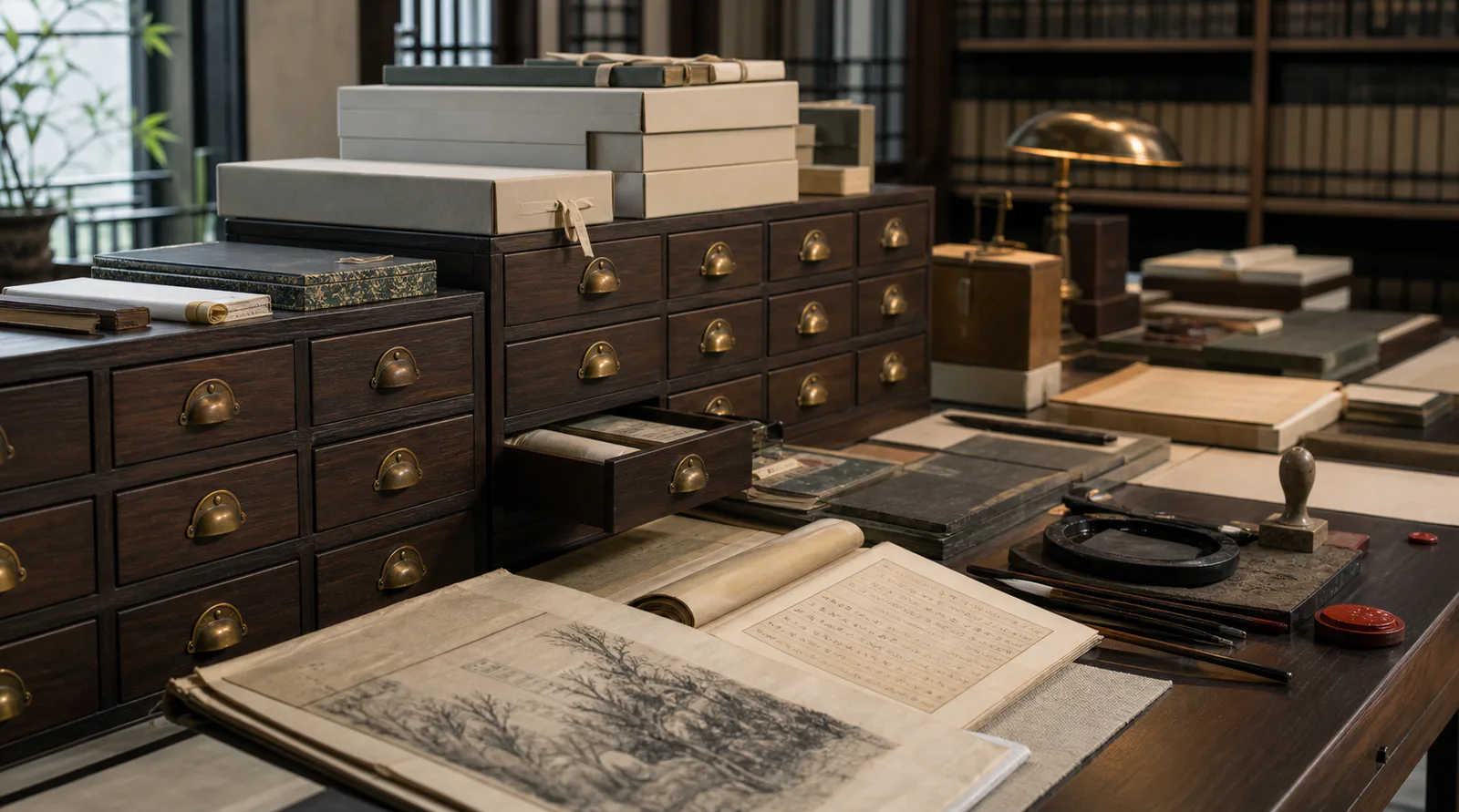
A research table joining texts, catalogues, manuscripts and digital resources

01Four research routes

Find sources by research question

One name may belong at once to method, history, text and social practice. These four routes interconnect, but answer different questions.

02Layered reading

Three depths of reading

The library separates public orientation, specialist study and independent research. You may move quickly, but should not skip checks of terminology, period and source type.

  1. 01

    Public orientation

    Read atlas summaries, the historical overview and glossary definitions to establish names, periods and families.

    For first encounters with Chinese mantic arts
  2. 02

    Specialist study

    Enter a dossier's principles, texts, evidence limits and related systems; record differences among editions and lineages.

    For learners with a defined field
  3. 03

    Independent research

    Return to primary texts, catalogues, archaeology and institutional databases; publish citations, procedures and uncertainties.

    For papers, translation, reconstruction and digital projects

03Evaluating sources

Six dimensions of source evaluation

An institutional page may offer only an introduction; a lineage manuscript may preserve a valuable lead. Evaluation asks exactly what a source can establish, regardless of institutional or lineage status.

01

What is the material?

Received edition, excavated manuscript, object, oral account, paper and modern manual support different claims.

02

How is it dated?

Separate the date claimed in a text, the surviving edition, attribution and the date of modern cataloguing.

03

Can the passage be located?

Record chapter, fascicle, page, edition, collection number or a stable link whenever possible.

04

Tradition or research conclusion?

Layer lineage interpretation, cultural narrative, historical claim and modern validation.

05

Can the procedure be reproduced?

Charts and calculations require inputs, rules, calendar conventions and intermediate steps.

06

Are the limits explicit?

Cases do not generalize automatically; mantic content does not replace medical, legal or financial advice.

04Source catalogue

Public source catalogue

These links are the sources already annotated in dossiers and the history: museums, universities, research institutes, academic publishers and digital text projects. External content and availability remain under the responsible institution.

Current context · 太乙

6 / 58 sources

zh.wikisource.orgWeb pageHistorical abstract and preface

太乙金鏡式經(四庫全書本)· 提要與序

The Siku abstract and preface of Taiyi Jinjing Shijing record attribution, ten-juan structure, a later-addition observation and editorial criticism.

Responsibility
Work attributed to Wang Ximing of the Tang; abstract by Siku editors; Wikisource transcription
Identifier / locator
提要 / 太乙金鏡式經序
Year and version
Online transcription of the Siku edition; ten juan; no folio collation completed
Reading and citation notes
Locating the evidence
The abstract's opening attributes authorship to Wang Ximing of the Tang and notes a calculation reaching the Song's Jingyou first year. Its closing critique and the separate preface have distinct argumentative roles.
Scope and limitations
This online transcription was not collated against images in this review. A Qing editorial observation does not date every passage. Links to volumes one, two and four locate the same transmitted edition, not independent witnesses.

Note reviewed

Open source
zh.wikisource.orgWeb pageTranscribed historical procedures

太乙金鏡式經(四庫全書本)· 卷一

Volume one covers epoch counts, cycle divisions, Taiyi and Tianmu placement, and monthly, daily and hourly methods.

Responsibility
Attributed to Wang Ximing of the Tang; Wikisource transcription; the abstract notes later additions
Identifier / locator
卷一 · 推上元積年 / 積太乙所在法 / 推天目所在法
Year and version
Online transcription, not collated folio by folio against a physical witness
Related reading太乙
Reading and citation notes
Locating the evidence
Locate the epoch, Taiyi-position and Tianmu-position headings and the separate time-scale procedures. The later Kaiyuan-12 statement gives 1,937,281; the relevant reduction chain uses 360, 72 and 24.
Scope and limitations
Counting origin, exclusion conventions and exact-division cases require dedicated checking; the text includes gaps and differing counts. Reproducing explicit arithmetic does not establish a modern calendar converter.

Note reviewed

Open source
zh.wikisource.orgWeb pageHistorical positions and names

太乙金鏡式經(四庫全書本)· 卷二

Volume two describes three-year palace residence, exclusion of the centre, Taiyi palace numbers, gates and sixteen named stations.

Responsibility
Attributed to Wang Ximing of the Tang; Wikisource transcription
Identifier / locator
卷二 · 推太乙所在法 / 推九宮所主法 / 推十六神所主法
Year and version
Siku-edition transcription; positions and names located by section
Related reading太乙
Reading and citation notes
Locating the evidence
Use the Taiyi-placement heading for residence, the Nine-Palace heading for Qian 1 through Xun 9, and the Sixteen-Agents heading for branch and corner names.
Scope and limitations
The diagram is an editorial teaching reconstruction, not an artefact replica. Political and disaster interpretations remain historical claims; reproducing positions does not validate them.

Note reviewed

Open source
zh.wikisource.orgWeb pageHistorical role and relation definitions

太乙金鏡式經(四庫全書本)· 卷四

Volume four defines host and guest through scenario, precedence and response; the adjacent passage treats mutual restriction.

Responsibility
Attributed to Wang Ximing of the Tang; Wikisource transcription
Identifier / locator
卷四 · 推主客 / 推主客相闗法
Year and version
Online Siku-edition transcription; no variant-edition collation completed
Related reading太乙
Reading and citation notes
Locating the evidence
Locate the field-array and settled-position conditions under host and guest, and the Gaochong/Taicu and Yinzhu/Dizhu examples under mutual restriction.
Scope and limitations
These are internal textual rules and interpretations. They support textual analysis here, not a complete military-divination system or advice for real conflict.

Note reviewed

Open source
catalog.digitalarchives.twWeb pageInstitutional union-catalogue record

太乙金鏡式經 · 故庫018063–018064

Catalogue metadata for the Palace Museum's Taiyi Jinjing Shijing: 故庫018063–018064, two volumes of the Wenyuan Pavilion Siku copy from the Qianlong period.

Responsibility
Catalogue attribution: Wang Ximing of the Tang; Digital Archives union-catalogue record
Identifier / locator
故庫018063–018064 · 排架號3133
Holding institution
National Palace Museum, Taipei
Year and version
Qianlong-period Wenyuan Pavilion Siku manuscript copy; two thread-bound volumes
Reading and citation notes
Locating the evidence
Consult identification for the accession and shelf location 3133, description for edition, format for two volumes and management for the National Palace Museum.
Scope and limitations
This review uses the union catalogue. Its original-resource link now opens the museum search homepage; item images were not examined. Keep attributed dynasty, copying period and web citation dates distinct.

Note reviewed

Open source

RIS export retains filtered results and verified bibliographic fields. Translators and holding institutions remain notes; manuscript dating is not a publication year. Unverified fields stay blank.

05Citation record

Elements of a citation record

When pages, editions or interpretations change, a clear record lets you and later readers retrace the same evidentiary path.

  1. 01Author or responsible institution
  2. 02Title and document type
  3. 03Edition, fascicle or collection number
  4. 04Stable URL and access date
  5. 05Page number for the cited passage
  6. 06Your inference separated from the source