
候Mantic arts dossier · Celestial omens and signs
国家星占与天象占候
Guójiā Xīngzhān yǔ Tiānxiàng Zhànhòu·State astrology and celestial omenology
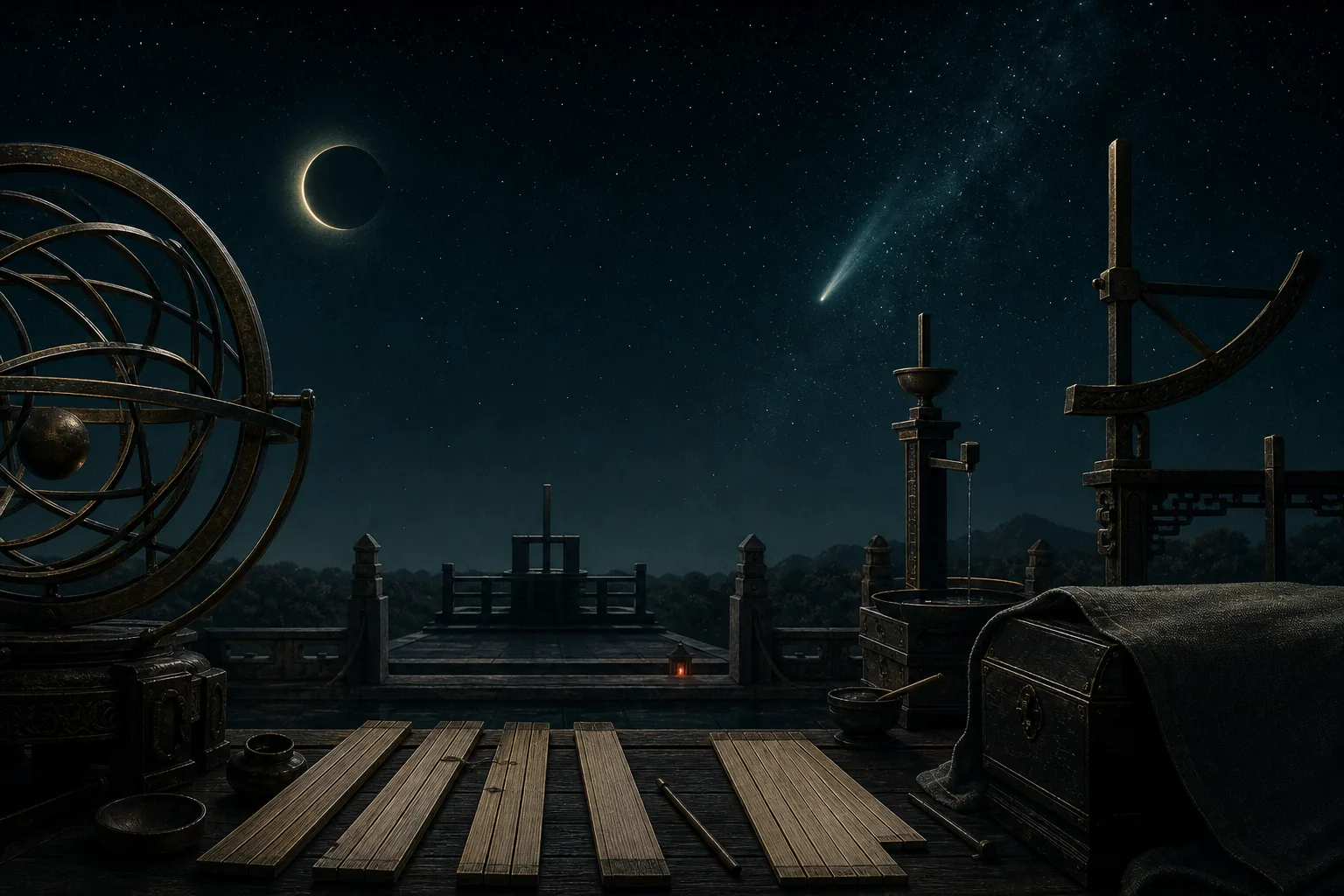
Observation of eclipses, comets, guest stars, planetary configurations and unusual celestial events, interpreted through star offices, terrestrial correspondences and political order.
- Aliases
- celestial offices, star divination, omenology
- Formation
- Early records in Shang-Zhou; systematized in Warring States-Han and long institutionalized
- Evidence status
Study notes & citation
国家星占与天象占候. Institute of Chinese Mantic Arts. https://www.manticarts.com/en/arts/celestial-omens
On this page
01Core principles
Core principles
Translate formulas into structure: what enters, how the model is arranged, and which relations drive interpretation.
Observers recorded time, direction, color, duration and motion, then linked the event through star offices, terrestrial fields, phases and inherited omen statements to rulers, war, disaster or harvest.
Key concepts
- star offices
- guest stars
- five planets
- anomalies and portents
02Origins and historical development
Origins and historical development
Keep traditional accounts, surviving evidence and later transformations distinct.
Shang-Zhou sources contain celestial inquiries; Warring States-Han developed star offices and state bureaus. Imperial observers combined observation, calendar and omen interpretation, leaving records valuable to modern astronomy.
STUDY / Guójiā Xīngzhān yǔ Tiānxiàng Zhànhòu
Observation and celestial-omen interpretation
- Materials and inputs
- Chronology, observation, textual locator and omen commentary
Research question
Where does observable description end and political interpretation begin?
Practical exercise
Annotate time, direction, form, interpretation and later commentary in one passage. Preserve dating uncertainty rather than forcing a modern identification.
03Evidence limits and research debates
Evidence limits and research debates
Distinguish traditional interpretations, documented material and claims requiring testing.
Historical observations have value for the history of science, but their political prognostications are not thereby validated by modern astronomy. Observation and interpretation must be separated.
This dossier supports historical, textual and methodological study. Internal traditional explanations are not modern empirical validation and do not replace medical, legal, financial or other professional advice.
04Core texts and materials
Core texts and materials
- 01Records of the Grand Historian, Treatise on Celestial Offices
- 02Book of Han, Treatise on Astronomy
- 03Yisi Zhan
- 04Kaiyuan Zhanjing
- 05Mawangdui Wuxing Zhan