象Mantic arts dossier · Divination and correlative foundations
河图、洛书与九宫
Hétú, Luòshū yǔ Jiǔgōng·River Chart, Luo Writing and the Nine Palaces
Spatial-numerical models of parity, generative numbers, center, cardinal and corner positions; a foundational node for the Three Boards, fengshui, date selection and Song correlative Yijing studies.
- Aliases
- Hetu-Luoshu, nine-palace numbers, diagrammatic Yijing studies
- Formation
- Concepts attested early; familiar dot diagrams largely stabilized in the Song
- Evidence status
Study notes & citation
河图、洛书与九宫. Institute of Chinese Mantic Arts. https://www.manticarts.com/en/arts/hetu-luoshu
On this page
01Core principles
Core principles
Translate formulas into structure: what enters, how the model is arranged, and which relations drive interpretation.
Hetu-Luoshu diagrams arrange numbers spatially and interpret generation and change through yin-yang, the five phases, direction and cycles. The Nine Palaces coordinate number, time and position around a center and eight directions.
Key concepts
- generative numbers
- nine palaces
- odd and even
- cardinals and corners
02Origins and historical development
Origins and historical development
Keep traditional accounts, surviving evidence and later transformations distinct.
The Xici and Hongfan preserve concepts of the River Chart and Luo Writing, while familiar black-and-white dot diagrams emerged through Han-Song textual development. Liu Mu, Shao Yong, Cai Yuanding and Zhu Xi did not always agree on nine, ten or which diagram bore which name.
STUDY / Hétú, Luòshū yǔ Jiǔgōng
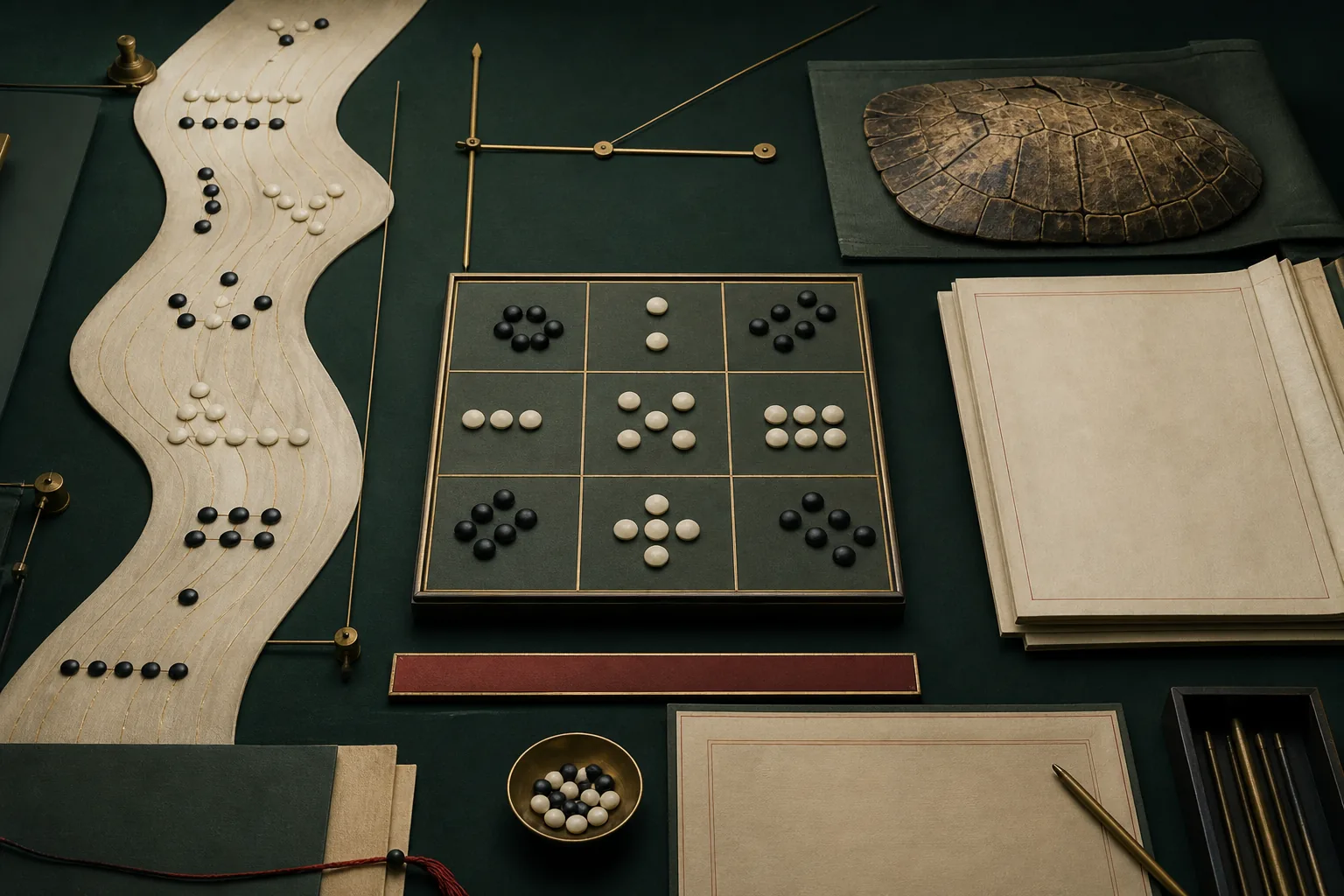
Versions of Hetu and Luoshu diagrams
- Materials and inputs
- Edition-specific image, number positions and caption
Research question
Do labels, number sequences and directions agree across editions?
Practical exercise
Number every point in two sourced diagrams. Record colors, center and orientation; separate observed layout from cosmological interpretation.
03Evidence limits and research debates
Evidence limits and research debates
Distinguish traditional interpretations, documented material and claims requiring testing.
The dragon-horse and divine turtle are cultural origin narratives; early textual mentions do not prove that Song dot diagrams descended unchanged from Fuxi or Yu.
This dossier supports historical, textual and methodological study. Internal traditional explanations are not modern empirical validation and do not replace medical, legal, financial or other professional advice.
04Core texts and materials
Core texts and materials
- 01Zhouyi, Xici
- 02Documents, Great Plan
- 03Introduction to Yijing Learning