兆Mantic arts dossier · Dreams, characters and popular divination
求签、签诗与杯珓
Qiúqiān, Qiānshī yǔ Jiǎobēi·Divination lots, oracle poems and moon blocks
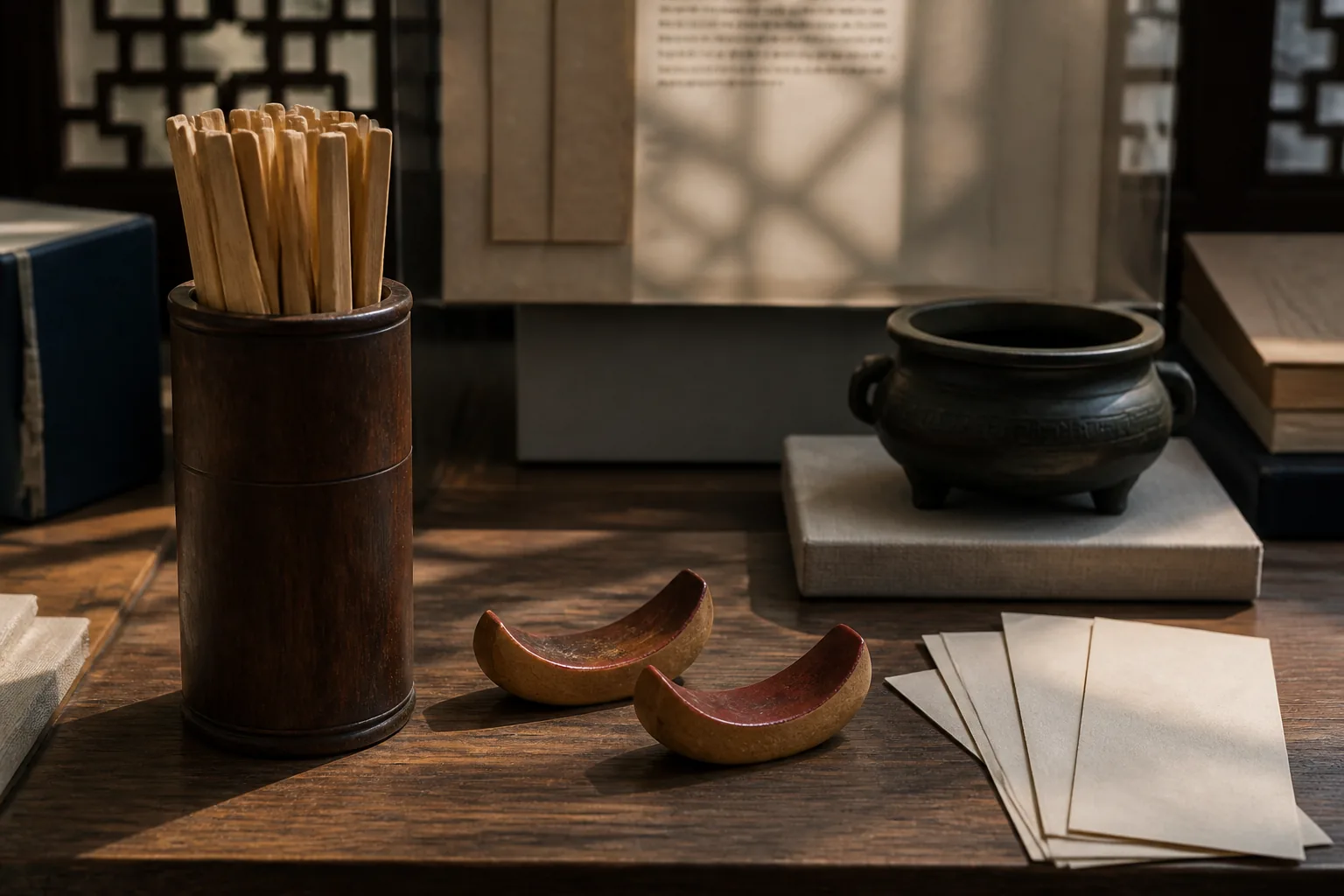
A common temple and popular religious practice drawing numbered lots or casting crescent blocks. Within the relevant faith tradition, results are interpreted as divine responses through poems, allusions or affirmative-negative-laughing signs.
- Aliases
- lot divination, oracle sticks, jiaobei, moon blocks
- Formation
- Developed with medieval and later temple and local religious practice
- Evidence status
Study notes & citation
求签、签诗与杯珓. Institute of Chinese Mantic Arts. https://www.manticarts.com/en/arts/lots-jiaobei
On this page
01Core principles
Core principles
Translate formulas into structure: what enters, how the model is arranged, and which relations drive interpretation.
Within a ritual and deity-specific setting, a number or block result is produced. Lot books supply poems and stories; moon-block traditions may require repeated confirmations for assent, denial or an improperly framed question.
Key concepts
- lot cylinder
- oracle poem
- affirmative blocks
- negative and laughing blocks
02Origins and historical development
Origins and historical development
Keep traditional accounts, surviving evidence and later transformations distinct.
Lot divination developed with Buddhist-Daoist temples, local cults and printed oracle books, including Guanyin, Lüzu and Guandi corpora. Moon blocks are widespread across Chinese religious communities and neighboring regions.
STUDY / Qiúqiān, Qiānshī yǔ Jiǎobēi
Ritual procedure and text in lots and blocks
- Materials and inputs
- Public ritual description, lot number, verse edition and interpretation
Research question
How do verse and ritual process contribute meaning separately?
Practical exercise
Map questioning, drawing, confirmation and interpretation from published fieldwork, marking local variants and separating participant words from analysis.
03Evidence limits and research debates
Evidence limits and research debates
Distinguish traditional interpretations, documented material and claims requiring testing.
This religious divination practice has no single algorithm or fixed lot corpus. Even hundred-lot collections can differ completely, and some elements reflect cross-cultural circulation and localization.
This dossier supports historical, textual and methodological study. Internal traditional explanations are not modern empirical validation and do not replace medical, legal, financial or other professional advice.
04Core texts and materials
Core texts and materials
- 01Temple lot books and local inscriptions
- 02Religious and popular sources since Song-Yuan