太乙
Tàiyǐ · Taiyi cosmic-board calculation
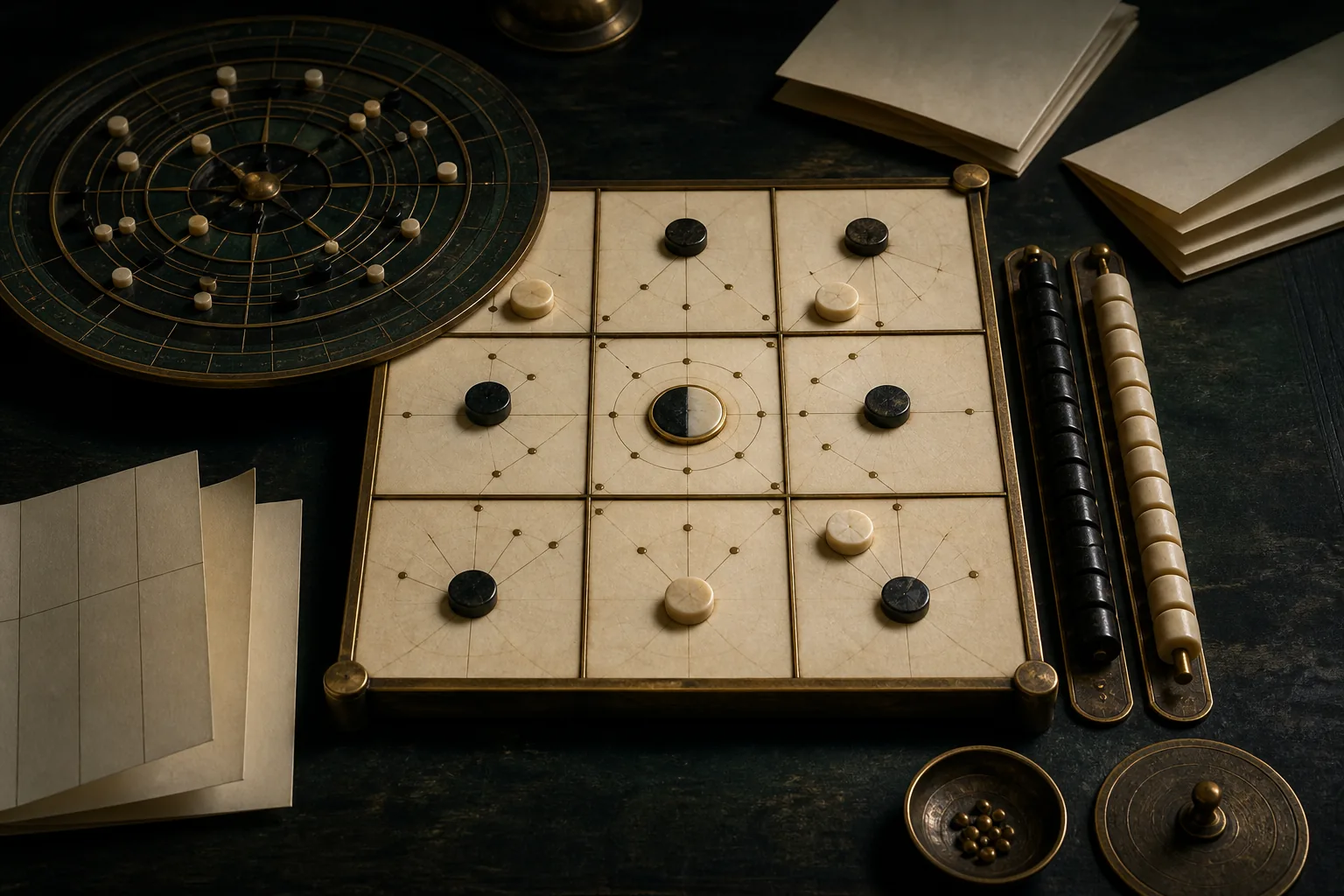
One of the Three Boards, arranging Taiyi and associated agents through accumulated years, epochs, nine palaces and configurations, traditionally for state affairs, warfare, disasters and long-term cycles.
L.01MANTIC ARTS LIBRARY
Thirty-four core dossiers across nine families. Explore principles, formation, primary texts, school differences and the limits of evidence.

Tàiyǐ · Taiyi cosmic-board calculation
One of the Three Boards, arranging Taiyi and associated agents through accumulated years, epochs, nine palaces and configurations, traditionally for state affairs, warfare, disasters and long-term cycles.
Qímén Dùnjiǎ · Qimen Dunjia
A nine-palace system placing the Three Wonders, Six Instruments, Eight Gates, Nine Stars and spirits according to season, date and yin-yang rotation to analyze timing, direction and action.
Dà Liùrén · Great Liuren
A heaven-earth board places the monthly general over the divination hour; Four Lessons are built from the day stem-branch, followed by Three Transmissions, generals and lesson patterns, interpreted within the tradition as a matter's origin, development and resolution.
Dà Liùrén Jīnkǒujué · Liuren Golden Formula
A compact lesson built from the ground division, general, noble spirit and human origin, interpreted through phase relations, strength and agents.
Xiǎo Liùrén · Lesser Liuren
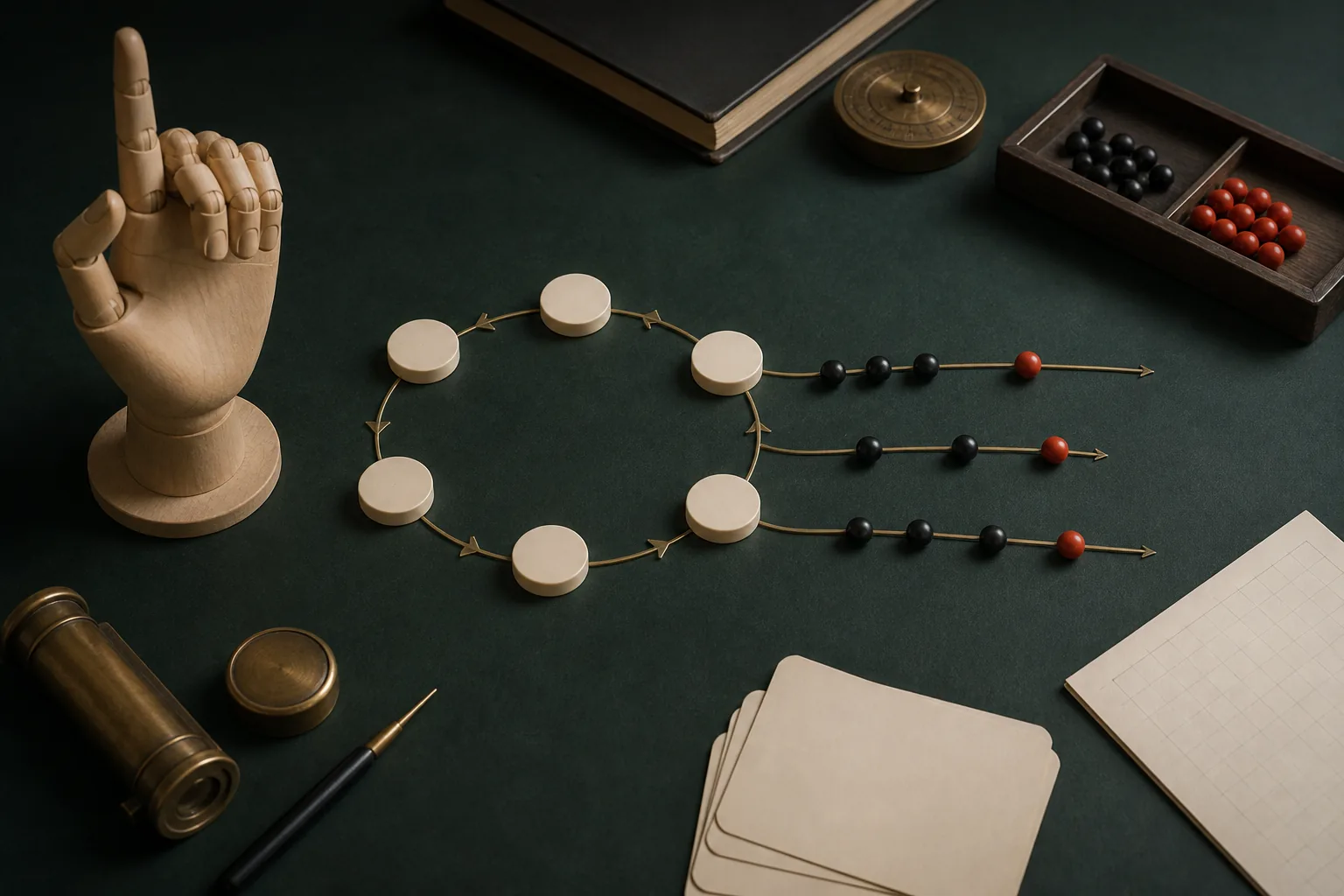
A quick hand mnemonic cycling month, day and hour through six states: Great Peace, Lingering, Swift Joy, Red Mouth, Small Fortune and Emptiness.
CONNECTED KNOWLEDGE
Each path connects a family, shared questions and related fields for comparative reading, without claiming proven historical transmission.
02KNOWLEDGE FAMILIES

From oracle bones, yarrow and numerical hexagrams to Hetu-Luoshu and Najia: the symbolic, temporal and numerical languages shared by many later systems.

Distinct traditions of inference built around hexagrams, lines, correlative roles, oracular texts and large-scale models of time.

Taiyi, Qimen, Liuren and related methods organize time and space through nine-palace models, cosmic boards, agents and calendrical rules.

Traditional interpretive systems organizing life narratives through birth time, stems and branches, palaces or celestial positions.

From state astrology to winds, cloud forms and phenology: how observations became political and human interpretation.

Approaches to dwellings, graves, settlements and landscapes through form, orientation, timing and spatial order.

Historical systems of classification and analogy based on appearance, bones, voice and movement, studied together with their risks of bias.

Traditions matching activities with calendrical days, seasonal nodes, the Twelve Officers and other almanac factors.

Lots, moon blocks, character analysis, dream books and local quick methods reveal the diversity of divination in everyday life.
03Scope and classification
No closed, universally accepted list covers every Chinese mantic art. Names overlap, divide, disappear, acquire pseudonymous authors and are reinvented. This atlas centers identifiable texts, living systems and significant branches, with its scope and evidence levels made explicit.
Supported by datable material, catalogs, objects or verifiable text.
How a lineage or book tells its story; not automatically a modern historical finding.
A culturally meaningful origin narrative that does not establish a date.
Disagreement over author, composition, genealogy or algorithmic relationship.
04Branch index and extended dossiers
These names remain in a traceable branch index. They become independent dossiers only when rules, dates and relationships can be described with adequate evidence.
Six Lines: Huozhulin, Wenwangke, Huangjin Ce, hidden lines, advancing-retreating signs and timing schools
Qimen: rotating, flying, split-term, intercalary, Maoshan, hourly, daily and selection approaches
Liuren: lesson-pattern, correlative, case-based, Golden Formula and the genealogically uncertain Lesser Liuren
Fate calculation: nayin luming, Ziping pattern, strength, climatic adjustment, spirits, Taiyi natal methods, nine-palace annual movement and hand mnemonics
Astral nativities: Qintang, Guolao, celestial-office planets, Seven Governors and Four Auxiliaries, animal-star and lodge traditions
Fengshui: form, Sanhe, Sanyuan, Xuankong, Flying Stars, Eight Mansions, living and burial approaches and compass layers
Physiognomy: face, bone, hand, voice, gait, complexion and moles, with cross-cultural origins marked where needed
Miscellaneous methods: hidden-object guessing, inverse puncture, emptiness, animal calls, bodily signs, anomalies, board games, coins, dominoes and dice